History of the museum
Traditionally, the date of foundation of the Rivne Regional Museum of Local Lore is considered to be February 3, 1940, when the Rivne Regional Committee of the Communist Party of Ukraine established the Rivne Museum of History and Local Lore on the basis of the city's previously existing economic museum.
In fact, the history of museums in Rivne began in 1908 at the Society of Agriculture.
This is evidenced by the correspondence of the Volyn Gendarmerie Department with its structural unit in Rivne, preserved in the Central State Historical Archives of Ukraine (Kyiv).
In fairness, some researchers believe that the museum appeared in 1906, citing Mieczysław Orłowicz's Illustrated Guide to Volyn, published in 1929.
The main inspiration for the museum was Edmund Ockęcki, who also served as the head of the warehouse and store of an agricultural society and formed an extensive network of personal contacts with many local landowners of mostly Polish noble origin, which allowed him to collect rare items related to the struggle for Polish independence in the nineteenth century in a short time.
The collection of historical relics of the Poles of Volhynia was exhibited alongside natural, archaeological, numismatic, and ethnographic relics that E. Okiencki managed to collect in two rooms of the society's warehouse and store for visitors to see. They could be viewed both independently and during excursions conducted by Ockęcki himself.

Note about the museum in m. Rivne. "Izvestiya Imperialskoy archeologicheskoy komissiya. Addendum to issue 37. Spb, 1910".
The 1910 provincial newspaper Zhyttia Volyn and the Izvestia Imperial Archaeological Commission mention the collections of medals, coins, and archaeological finds that were kept there.
Later, another museum department began to work on the basis of the collection of old paintings, prints, books, and manuscripts.
During the First World War and the Ukrainian Revolution of 1917-1921, the museum in Rivne ceased to exist.
In the 1921-1939s, the territory of the region was part of Poland.
In the mid-1920s, thanks to local enthusiasts and intellectuals, a natural history museum began operating in Rivne. At that time, there were only similar museums in Warsaw, Krakow, and Lviv.

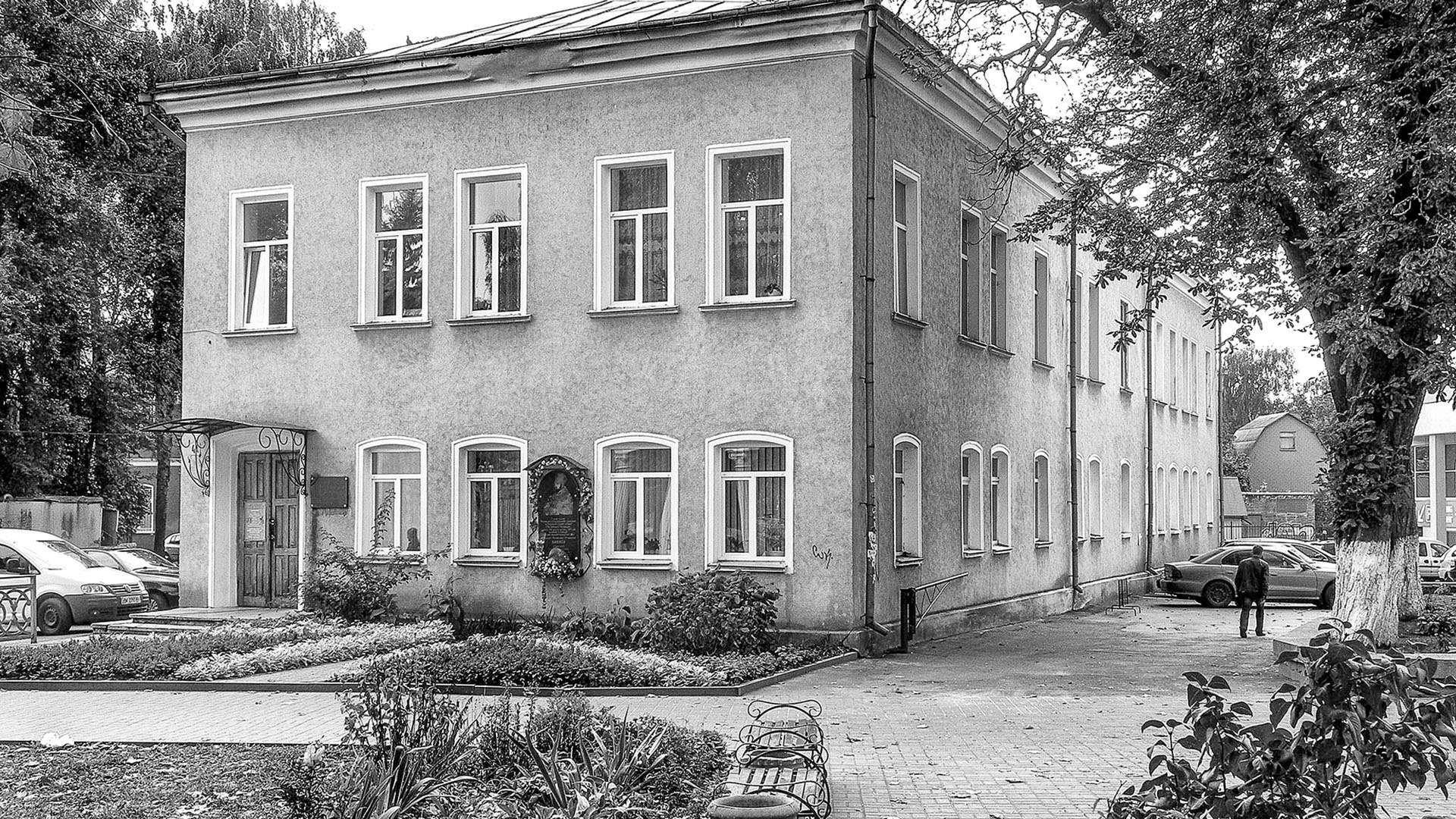
In 1936, the Volyn Economic Museum was opened in Rivne, located in the building of the modern Diocesan Administration of the Rivne Diocese (now 16 July Street, 4a).
The museum was initiated by the Lublin Chamber of Commerce and Industry. The museum's collections include a copy of the charter of the Volyn Economic Museum in Rivne.

The building of the Volyn Economic Museum (16 July, 4a). Modern photo.


The idea was supported by the city authorities and some industrial enterprises.
The museum exhibition featured materials that reflected the "economic life" of Volhynia and exhibited a few recovered exhibits from the previous museum.
Photo:
The exhibition of the Volyn Economic Museum in Rivne. Photo from the 1930s.
The exhibition of the Volyn Economic Museum in Rivne. Photo from the 1930s.
The exhibition of the Volyn Economic Museum in Rivne. Photo from the 1930s.Ethnographic collection of Jakub Hoffmann. The exposition of the Volyn Economic Museum in Rivne. Photo from the 1930s.
After Soviet rule came to Rivne in September 1939, the museum was liquidated. However, in 1940, the Rivne Museum of History and Local Lore was established on the basis of its collections. It had departments of nature, history, and anti-religious propaganda. According to the staff list, the museum employed 6 people: a director, a researcher, a guide, an accountant-secretary, a cleaner, and a watchman. Later, an artist was added to the staff. Ivan Dubovskyi was the first director of the Rivne Museum from February 21 to September 9, 1940.
To replenish the museum's collections, the next director of the museum, P.I. Slabospytskyi (September 9, 1940 - summer 1941), and his staff members V. Kuchynskyi, Y. Shumovskyi, and J. Panek, conducted natural history, ethnographic, and archaeological expeditions, and in the summer of 1940 began to compile inventories of property in former lordly estates: Shpanov, Novomalyn, Mizocha, Derazhne, Derman, etc. During this period, the museum received many unique exhibits: paintings, books, furniture, and tableware. The museum was also actively engaged in exhibition activities. The main problem of the museum was the lack of premises. Despite numerous instructions from above to provide the museum with a building, they remained only on paper. In fact, until the outbreak of war in 1941, the museum wandered around different premises, which can be traced through the addresses on the museum's official documents.
During the period of German occupation, the Rivne Regional Museum ceased its activities for some time. The premises where it was located were occupied by a military unit, and many of the exhibits of the art department were taken away by the military.
Yuriy Shumovsky initiated the restoration of the museum. It was he who petitioned the German authorities for the activities of the institution and the preservation of the historical and cultural values collected by his predecessors.
The document submitted for approval in August 1941 proposed the following museum staff: "Director of the Museum - Karl Kostyrko; Head of the Art Department - Petro Zinchenko; Head of the Historical and Archaeological Department - Yurii Shumovsky; Head of the Museum Library - Varvara Besedovska; Keeper of the Building and Property - Oleksandr Brynda." Karl Kostyrko was not the director for long. In December of the same year, he switched to teaching. However, it was Kostyrko who played an important role in preserving historical memory by participating in the creation of museum exhibitions, as the artist's artistic and aesthetic vision helped to select items to organize museum collections.
According to an order of the Rivne City Council, an inventory of available museum objects was made by December 4, 1941. It is thanks to these inventory lists that it is possible today to attribute existing museum objects.
Preparatory work for the museum's opening lasted almost a year. On November 4, 1942, "The Ukrainian Museum of Rivne opened for public and school visits," as the Volyn newspaper reported. Initially, the museum was supposed to open in the building that housed the Volyn Economic Museum. However, as Shumovsky recalls, "the SS headquarters arrived in Rivne, and the SS Obersturmführer took the best tapestries, ceramics, and images and ordered the house to be vacated in one day for the needs of the SS headquarters. The mayor provided a second ordinary house for the museum at 6 Korolenko Street."

Museum staff outside the building at 8 Korolenko Street. Photo, 1943.
This house has not been preserved. Korolenko Street was small and located in the area of the modern Independence Square.
Until 1943, the museum employed two people: director Yurii Shumowski and librarian Aniela Liaskivska. In early 1943, Oleksandr Chaika was hired as an assistant librarian and J. Panek as a research assistant (temporarily). The museum had four departments: geological, archeological, ethnographic, and historical and artistic. As of the end of 1942, it had 898 exhibits. The library had 14580 books. This museum in Rivne operated until early 1944.
After the Nazis were expelled from Rivne in late February 1944, the Rivne Museum of History and Local Lore resumed its work. In August, it was given a building at 33 Krasnoarmiiska Street (now Simon Petliura Street) with an exhibition area of 175 m². I.M. Dubovskyi, who had headed the museum in 1940, was appointed director. The museum staff consisted of 9 employees, including two researchers.

The museum building at 33 Krasnoarmiyska (now S. Petliura) Street. Director I. Dubovskyi stands on the doorstep. Photo, 1948.


Photo:
The exhibition of the Rivne Museum of History and Local Lore. Photo, 1940s.
Exhibition to mark the 300th anniversary of the Pereyaslav Rada of 1654. Photo, 1954.
The exhibition of the Rivne Museum of History and Local Lore. Photo, 1950s.
Conducting expeditions to explore natural and historical monuments and replenish the museum with new exhibits, building a new exposition and creating exhibitions, and scientific and methodological work became the main activities of the museum in the following decades.
In 1946, Rivne residents saw a new museum exhibition.
In 1948, the museum's collection consisted of 10,785 items.
In addition to working to improve their exposition, museum scholars actively helped to create district, village, and school museums. In 1951, the literary-memorial museum of the writer M. Ostrovsky was opened in the village of Vilia (Ostroh district).
In the 1960s and 1980s, branches of the Rivne Museum of Local Lore were opened in almost every district. The Dubno Museum of Local Lore (1960) was the first of them. In Rivne itself, the Mykola Kuznetsov Museum (1974-1991) was opened on Partizaniv-Razvednykiv Street (now Yasna Street), and the Museum of the History of Religion and Atheism (until 1989, it operated in the Holy Resurrection Cathedral).
In 1966, the regional museum received a complex of buildings in the village of Plyasheva (Dubno district), on the site of the Battle of Berestets in 1651. Later, the Cossack Graves Museum-Reserve (now the Berestets Battlefield Museum) was opened there.
Between 1970 and 1995, researchers at the local history museum conducted archaeological research on the field of the Battle of Berestets (led by Ihor Sveshnikov, Doctor of Historical Sciences).
1975 р. The premises of the former men's gymnasium (19 Drahomanova St.), an architectural monument of national importance, were transferred to the Rivne Regional Museum of Local Lore.

The building of the gymnasium, since 1975 - Rivne Regional Museum of Local Lore. Photo from the 1980s.
The future historians M. Kostomarov and P. Kulish worked here as teachers, as well as the Nobel Prize-winning economist Simon Smith, the famous writer V. Korolenko, and the architect M. Peretiakovych.
The authors of the project of the new exhibition's artistic design were Rivne artists Viktor Hvozdynskyi and Feofan Bobryk. It was built together with the museum's scientists by the employees of the Kyiv and Rivne art and production workshops of the Art Fund of Ukraine.
The new exposition of the Rivne Museum of Local Lore opened in 1978. Two floors and 23 halls housed the expositions of the nature and history departments. (photos from the opening).
At this time, the staff was divided into administration (director, deputies for scientific and economic work, scientific secretary, and secretary of the office), researchers (departments of nature, history of pre-Soviet, history of Soviet society (since 1980), and history of the Soviet Union). Since 1980, the department has been divided into two: the history of the construction of socialism and the history of developed socialism), collections (with positions of librarian, restorer, and caretaker), scientific atheism, scientific and methodological, scientific and educational work, protection of cultural heritage, and economic services.


Photo:
The exhibition "The Origin of Life on Earth". Photo, 1980s.
Exposition. "The animal world of Rivne region". Photo, 1980s.
The exposition "Primitive communal system in the region". Photo, 1980s.
The exhibition "The Development of Feudalism in the Territory of the Region". Photo, 1980s.
Exposition "Folk costumes of Rivne region". Photo, 1980s.Paintings on the second floor of the museum. Photo, 1980s.
During archaeological expeditions, scientists explore the territories where the chronicled ancient Rus cities of Dorohobuzh, Peresopnytsia, Muravytsia, Basiv Kut, and Ostroh were located. At different times, the leaders were Józef Nikolchenko, Bohdan Pryschepa, and Oleksii Voitiuk.
During the 1970s, in order to identify and register sacred historical and artistic values, museum expeditions led by Volodymyr Mushyrovsky surveyed Orthodox churches in the region; in the 1980s, under the leadership of Viktor Lutz. In 1984, he brought the thirteenth-century icon of the Virgin Hodegetria from Dogohobuzh. Pavlo Zholtovsky, a doctor of art history, provided great assistance to museum staff in selecting monuments.
The natural history expeditions were conducted jointly with the Institute of Botany of the Academy of Sciences of Ukraine under the leadership of Anna Antonova.
The early 1990s saw a surge of interest in folk traditions, folklore, and clothing. Ethnographic expeditions (led by Alla Ukrainets) that passed through the region and especially studied the areas contaminated by the Chornobyl accident added new exhibits to the museum.
The museum was headed by Vasyl Sydorenko (February 26, 1971 - April 1984). In the following years, the museum's directors were: Vasyl Mandryk, Eduard Antonenko, Volodymyr Mushyrovsky, Oleksandr Bulyha Tetiana Samsoniuk (acting director), Oleksandr Bulyha, and Alla Zhyzkevych.
Since Ukraine gained its independence, changes have been made to the structure and exposition of the museum.
Independence
After Ukraine gained independence in 1991, changes began to take place in the museum's work. First, it was created as a sector, then as a department of ethnography. 1992 - the history departments were merged into one with two sectors: ancient and modern and contemporary history. Instead of the Department of Scientific Atheism, the Department of History of Religion and Art began to operate. An exhibition department was created. The restructuring of exhibitions began.
New exhibitions were launched on the second floor:
- "The National Liberation Struggle of the Ukrainian People in the Twentieth Century";
- "Eyes and soul were covered with wires" (about our fellow countrymen who were victims of political repression in the 1930s and 1950s);
- "Our land during the Second World War";
- "Stare Rivne";
- "Main occupations and crafts of Rivne region";
- "Folk costumes of Rivne region residents"
- "Our Spiritual Heritage" (exhibitions of Volyn and folk iconography);
- "Heroes do not die" (dedicated to the heroes of Maidan and ATO (opened in January 2017).
XXI century
At the beginning of the twenty-first century, two new museum departments and another building were opened: The Ulas Samchuk Literary Museum and the Amber Museum (17 Symona Petliury Street).
Digitalization has become a new area of the museum's activity. In 2021, a digital technology implementation sector was created (headed by Olga Morozova).
The museum's collection includes more than 300 thousand exhibits
Of these, more than 20 thousand are presented in the halls of permanent exhibitions and exhibitions. Unique exhibits include herbaria of rare plants of Rivne region, treasures of ancient Russian silver jewelry of the twelfth and thirteenth centuries, works of Volyn iconography, a collection of old prints, including the Ostroh Bible of 1581, objects of the Cossack era, sculptures by Tomasz Oskar Sosnowski, collections of coins, cold steel and firearms.
The museum is actively engaged in exhibition work, based on both its own stock collections and cooperation with other museum institutions, artists and collectors. Rivne museum collections have been repeatedly exhibited at exhibitions held not only in Ukraine but also abroad, in particular in Canada, Poland, and France.
Every year, the museum hosts a scientific and practical conference that invites scholars and local historians from different regions of Ukraine and abroad. The conference results in the publication of a scientific and local history collection, Scientific Notes of the Rivne Regional Museum of Local Lore.
The institution also hosts academic readings, roundtables, and seminars on various topics.
In addition to traditional excursions and lectures, new methods of working with visitors of different age groups are used. These include museum holidays, themed evenings, nightly theatrical tours, quests, presentations of printed publications and films, meetings with famous personalities, etc.
The annual folklore and ethnographic festival «Museum Feasts» has been held in the museum's courtyard since May 1992 (initiated and organized by Alla Ukrainets).
Museum educational programs for children of all ages and young people, such as "Your Friend is a Museum," "Museum to School," and others, help to inform the younger generation about the people of Ukraine, their history, culture, and the need to preserve their historical and cultural heritage.
Today, the Rivne Regional Museum of Local Lore is a scientific, methodological, cultural, and educational center of the city and the region.